Coarse-Graining
Coarse-graining maps an atomistic structure onto a smaller set of beads. In MolScope this is deliberately educational: it helps you inspect mappings, compare representations, and build graph prototypes. It does not generate validated production simulation topologies.
cg = mol.coarse_grain("residue_com")
cg = mol.coarse_grain("residue_centroid")
cg = mol.coarse_grain("martini")
The result is still a Molecule, so it can be plotted, transformed, converted
to a graph, and analyzed.
Run molscope presets coarse-grain (or ms.list_presets("coarse-grain")) to
list the built-in bead mappings.
Built-in teaching mappings
Residue centre of mass
"residue_com" collapses each residue to one bead at the mass-weighted centre
of all atoms in that residue:
mol = ms.read("examples/data/1fqy.pdb")
cg = mol.coarse_grain("residue_com")

len(mol), len(cg)        # 1661 atoms -> 226 residue beads
cg.atom_names[:5]        # residue names carried as bead names
Mass weighting matters: a centre of mass is pulled toward heavier atoms, while a
centroid is the unweighted average of coordinates. Use "residue_centroid" when
you want the geometric centre instead:
com = mol.coarse_grain("residue_com")
centroid = mol.coarse_grain("residue_centroid")
Backbone/sidechain beads
"martini" is a simplified backbone/sidechain split inspired by Martini-style
coarse-graining:
bb_sc = mol.coarse_grain("martini")
bb_sc.atom_names[:6]     # ['BB', 'SC', 'BB', 'SC', ...]
For each residue, backbone atoms (N, CA, C, O, OXT) become a BB
bead and non-hydrogen sidechain atoms become an SC bead when present. MolScope
then adds a simple bead graph: within-residue BB-SC bonds plus sequential
BB-BB links along each chain.
Virtual sites can be added explicitly when you want a coordinate derived from existing beads without treating it as another atom-assignment bead:
bb_sc = mol.coarse_grain(
    "martini",
    virtual_sites=[{"name": "MID", "parents": [0, 2]}],
)
The virtual site is appended to the CG coordinates, marked with
cg.virtual_sites, preserved in mapping JSON, drawn as a distinct marker, and
exposed as a virtual_site flag in graph exports. Parent references are bead
indices in the CG model before virtual sites are appended; names are accepted
only when they are unique.
This is the useful concept to learn from Martini: represent groups of atoms as interaction sites, preserve an interpretable molecular shape, and work at lower resolution. Real Martini models also require bead types, bonded terms, nonbonded parameters, charges, exclusions, virtual-site topology sections, validation against reference atomistic/experimental behavior, and toolchain-specific topology files. MolScope does not attempt those production steps.
Custom residue mappings
mapping = {"ALA": {"BB": ["N", "CA", "C", "O"], "SC": ["CB"]}}
cg = mol.coarse_grain(mapping)
Custom index mappings
cg = mol.coarse_grain(
    {"head": [0, 1, 2, 3], "tail": [4, 5, 6, 7]},
    bonds=[("head", "tail")],
)
Name-based bonds are intended for unique bead names. Repeated names such as
BB and SC are ambiguous across residues; use bead indices for those.
Visualise the mapping
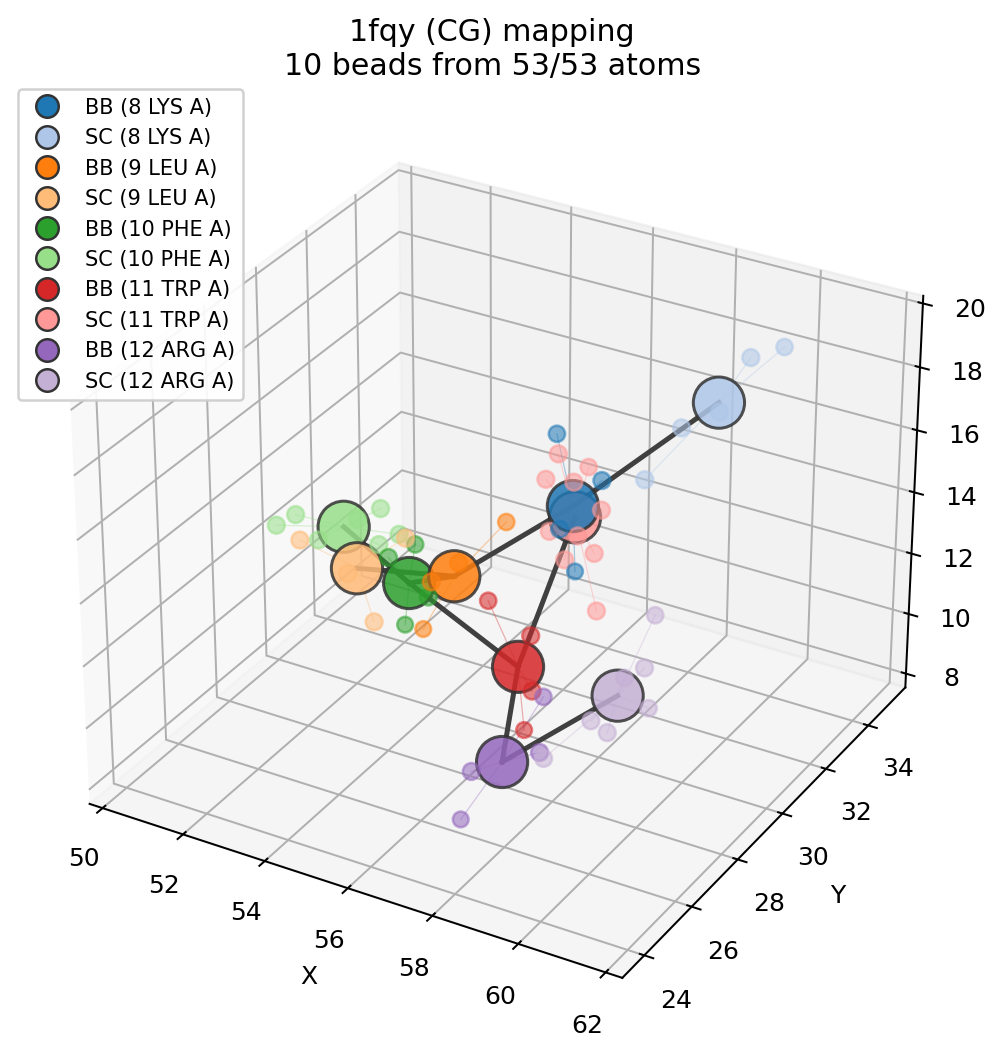
plot_mapping shows how the beads sit on top of the atoms they replace. Each
atom is coloured by the bead it was folded into, every bead is drawn as a large
translucent sphere at its position, thin lines join atoms to their bead, and the
CG bond network is drawn between beads. Atoms left unassigned appear as faint
grey crosses.
import molscope as ms

fragment = ms.read("examples/data/1fqy.pdb").select(resid=(8, 12))
cg = fragment.coarse_grain("martini")

ms.plot_mapping(fragment, cg)     # or: cg.plot_mapping(fragment)
For an interactive, rotatable overlay in a Jupyter notebook, use view_mapping
(needs the [viz] py3Dmol extra). It renders the atomistic structure as a
semi-transparent model with the beads drawn as solid spheres on top, so students
can rotate the mapping and see exactly which atoms each bead replaces:
cg.view_mapping(fragment)                       # or: ms.view_mapping(fragment, cg)
cg.view_mapping(fragment, atom_style="cartoon") # cartoon backbone for proteins
To compare mapping resolutions side by side, run:
uv run python examples/coarse_graining.py
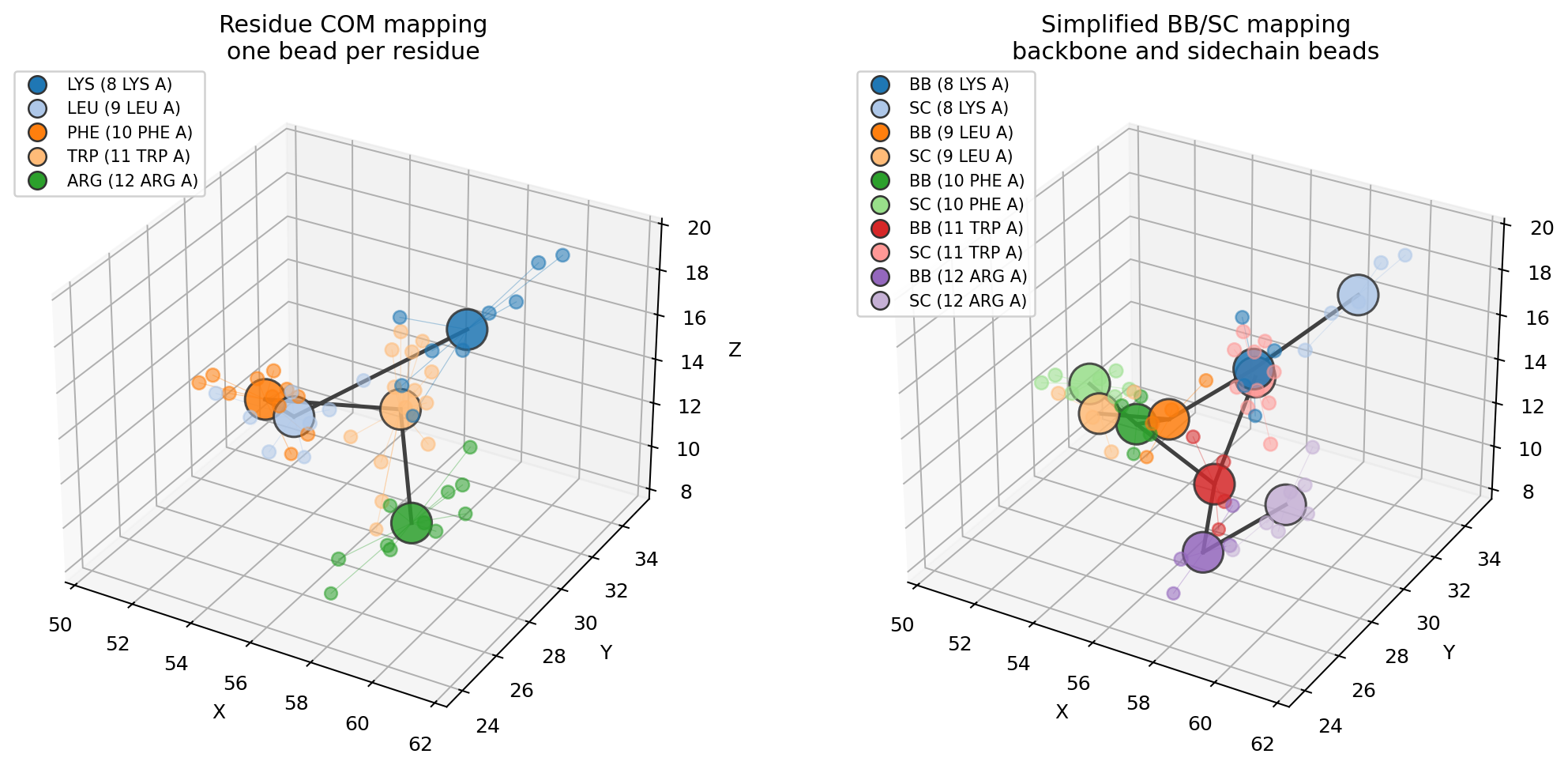
Pass the structure the CG model was built from (same atom order). The
atom-to-bead lines are drawn automatically for small structures; toggle them
with show_assignment=True/False, and the bead legend appears when there are
few enough beads to stay readable (max_legend).
From the command line
molscope coarse-grain maps a structure to beads and writes a coordinate file
you can open in PyMOL, ChimeraX, or Mol*:
molscope coarse-grain structure.pdb --mapping martini --out cg.pdb
molscope coarse-grain --fetch 1fqy --mapping residue_com --out cg.pdb
molscope coarse-grain structure.pdb --mapping martini        # summary only, no file
--mapping is residue_com (default), residue_centroid, or martini. The
output format follows the --out extension (.pdb, .cif, or .xyz); beads
are written as pseudo-atoms with their bead names (BB/SC for Martini), and
the bead bond network is written as CONECT records for .pdb output. .cif
and .xyz carry coordinates only, so prefer .pdb when you want the network to
show up in a viewer. The command always prints the mapping coverage.
Inspect the bead assignment
Every coarse-grained Molecule carries a structured report describing exactly
which atoms went into each bead:
cg = mol.coarse_grain("martini")
report = cg.coarse_grain_report

print(report.coverage())          # "426 beads from 1661/1661 atoms"
print(report.n_beads, report.n_assigned, report.n_dropped)

first = report.beads[0]
print(first.name, first.resname, first.resid, first.chain)
print(first.atom_indices)         # source-atom indices, in order
print(first.atom_names)           # ["N", "CA", "C", "O"]
print(first.reduction)            # "centre of mass"

if report.virtual_sites:
    site = report.virtual_sites[0]
    print(site.name, site.parents, site.rule, site.weights)
print(cg.mapping_report()) formats the whole thing as text (beads, dropped
atoms, and bonds), and cg.coarse_grain("...", return_report=True) returns the
(molecule, report) pair directly.
Export and reload a mapping
Save the mapping to JSON, reload it, and re-apply it to a structure. Because the
record stores per-bead atom indices, repeated bead names such as BB/SC
round-trip cleanly:
ms.write_cg_mapping(cg, "mapping.json")   # or: cg.write_mapping("mapping.json")

record = ms.read_cg_mapping("mapping.json")
cg2 = ms.apply_cg_mapping(mol, record)    # rebuild on the same (or matching) structure
cg_mapping_to_dict(cg) returns the same record as a plain dict without
touching disk. For inspection in tools that read index files, write a
GROMACS-style .ndx with one group per bead (1-based atom serials):
ms.write_cg_index(cg, "mapping.ndx") # or: cg.write_index("mapping.ndx")
The bead Molecule itself still writes as ordinary coordinates with its CG
bonds preserved:
ms.write_pdb(cg, "beads.pdb") # CONECT records carry the bead bonds
Simulation-skeleton exports
For a starting point in a production engine, MolScope writes topology skeletons: connectivity and per-bead bookkeeping, but no force constants or non-bonded parameters.
ms.write_cg_openmm_xml(cg, "cg.xml")   # OpenMM residue-template ForceField
ms.write_cg_itp(cg, "cg.itp")          # GROMACS [moleculetype]/[atoms]/[bonds]/[angles]
The OpenMM XML defines bead types, masses and bonds per residue template. The
GROMACS .itp lists beads as [atoms] (type CG_<resname>_<bead>, zero charge,
bead mass), the bead bonds, and [angles] enumerated from the bond network
(every i-j-k where i-j and j-k are bonds). Both omit force constants,
reference values and non-bonded parameters, so map onto a Martini /
elastic-network model and fill those in before running dynamics.
Mapping reports
cg = mol.coarse_grain("martini")
print(cg.mapping_report())

cg, report = mol.coarse_grain(mapping, return_report=True)
Limitations
MolScope is useful for interpretable coarse-graining prototypes, visual mapping inspection, and graph/ML representations.
It does not:
- assign Martini bead types or force-field parameters,
- assign force constants, reference geometries, charges, non-bonded or exclusion
terms (the
.itplists bond/angle connectivity only), or create dihedrals, - build validated production simulation topologies,
- write GROMACS
[ virtual_sites* ]topology sections, - validate elastic networks, bead chemistry, or thermodynamic behavior,
- replace a Martini preparation workflow.
The .ndx and JSON exports describe a bead assignment for inspection and reuse,
and the OpenMM XML and GROMACS .itp are topology skeletons; none are
simulation-ready force fields.